This page tells you what the numbers on a student’s Critical Reading Journeys (CRJ) reports mean, and what to do in class when a student is stuck on one of them. It follows one student, Jim, through his first four stories. Jim is a demonstration account that Altura completed, not a real child.
If you are looking for where the reports are and what is on each page, that is page 5 of CRJ in Your Week, Finding the reports; this page picks up where that one leaves off.
A few words you will see on this page. The Reading Buddy is the conversation partner on the screen that asks your student questions about a story. Every finished story gives you a report, a one-page summary of how the student handled it, and a transcript, the full conversation. The four measures are the four things the report rates, each from level 1 to level 4.
One student, four stories
Jim is in the grade 4 band, the set of 36 stories written for fourth graders, and he finished his first four over one weekend: Wagons West (fiction), Journey Through Our Solar System (an informational article), Lightning and Keys (a true story about Benjamin Franklin), and Voices from the Thirteen Colonies (a poem). His progress page, the page that shows his levels across stories, looks like this:
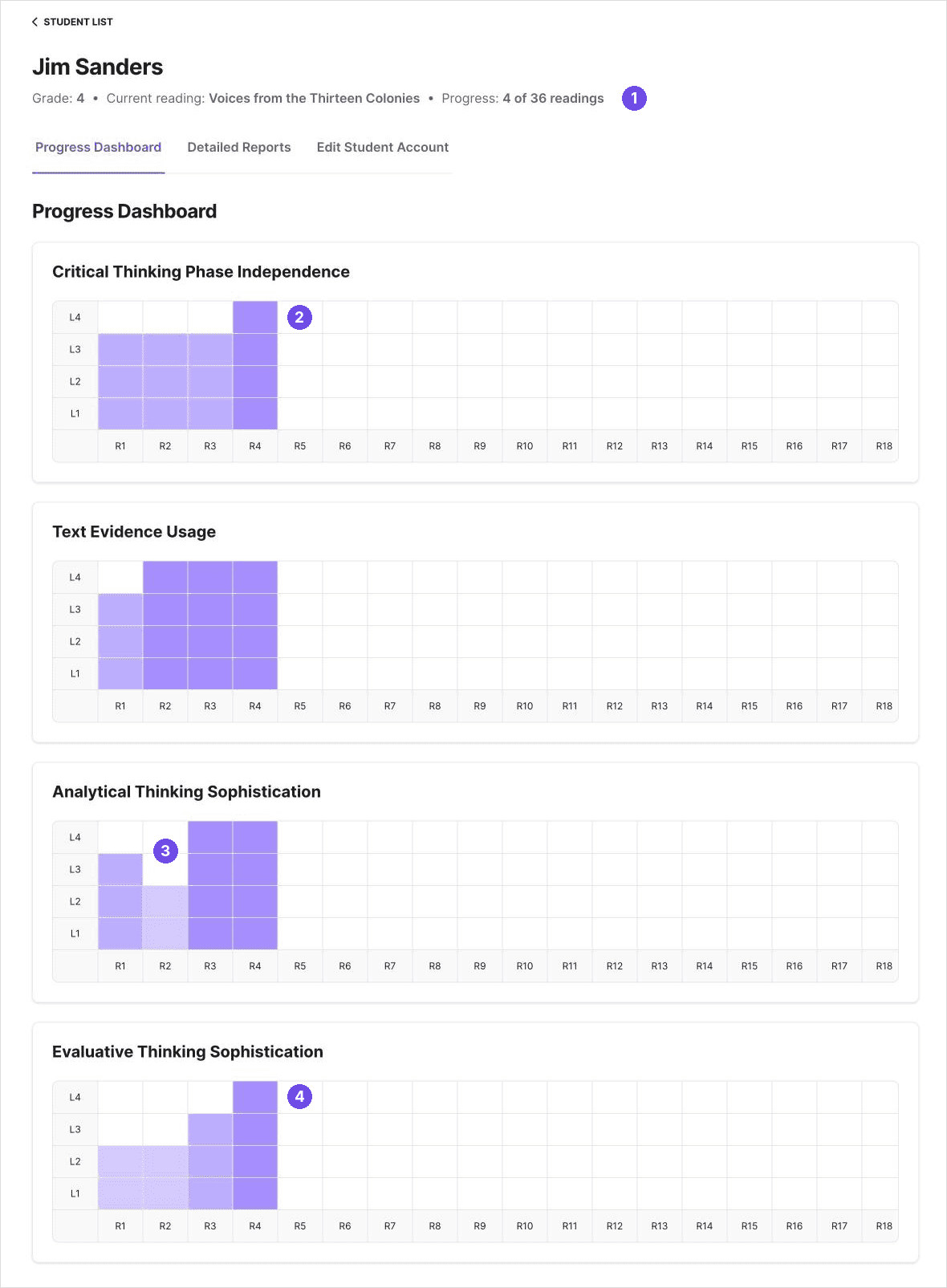
- This line shows the grade band and how many of its 36 stories the student has finished.
- Each column is one finished story, in order, and its height is the level, 1 to 4.
- The second story dipped to level 2.
- This measure moved slowest.
Critical Thinking Phase Independence is how often Jim answered the Reading Buddy’s question on the first try. A hint, a second ask, or an “I don’t know” counts against it. Jim went 3, 3, 3, 4: he said “I don’t know” twice on the Solar System article, and on the poem he answered every question the first time.
Text Evidence Usage is whether Jim’s answers point to the story. A character’s name, an event, or a quoted line all count; “it was hard” with nothing from the story does not. Jim went 3, 4, 4, 4.
Analytical Thinking Sophistication looks only at Dig In, the second of the four stops the Reading Buddy walks a student through in every story. It asks how much Jim explained: a because, more than one example, how the parts of the story connect. Jim went 3, 2, 4, 4; the dip is the Solar System article, where he could not find the pattern without help.
Evaluative Thinking Sophistication looks only at the third stop, Weigh It. This is Jim’s slowest measure: 2, 2, 3, 4.
Read the four charts as the shape of four conversations, not as four grades. A first story is a first conversation of this kind, and an informational article is harder to analyze than a story with a character in it.
What the levels look like in a student’s own words
Each report quotes one of the student’s answers as its example for each measure, and those examples are the quickest way to hear what the levels mean. Here is Jim’s report for Wagons West, his first story:
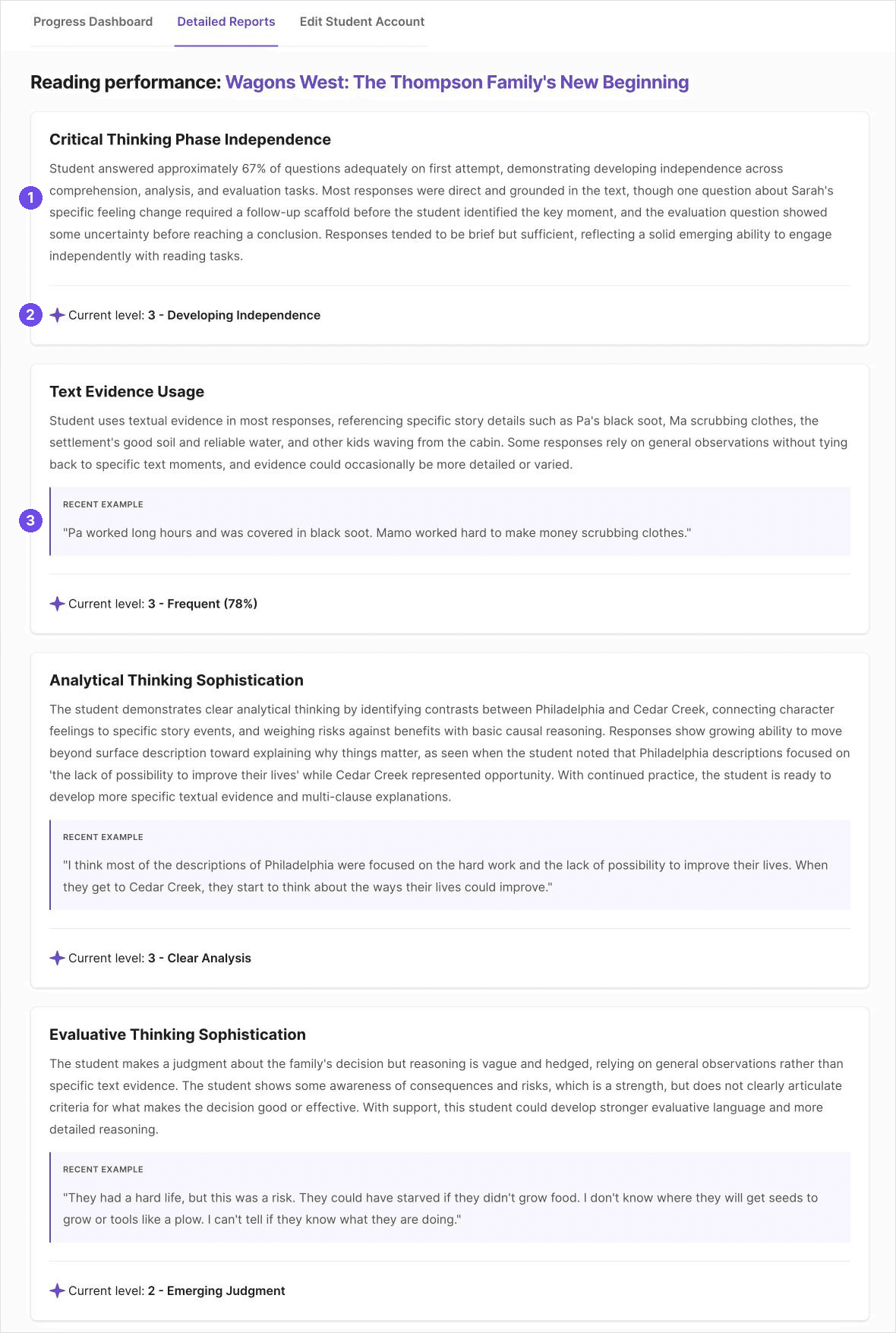
- Each measure opens with a few sentences on how the student handled it in this story.
- This line gives the level for this story, 1 to 4, with its label.
- The example is the student’s exact words, chosen by the report.
Level 2 is a judgment with no clear reason behind it. Asked whether the Thompson family’s move west was a good decision, Jim wrote: “They had a hard life, but this was a risk. They could have starved if they didn’t grow food. […] I can’t tell if they know what they are doing.” He sees the risk, never says what would make the move a good decision, and hedges.
Level 3 is a clear answer with a reason from the story, and room to go further. Asked how the story describes Philadelphia compared with Cedar Creek, Jim wrote: “I think most of the descriptions of Philadelphia were focused on the hard work and the lack of possibility to improve their lives. When they get to Cedar Creek, they start to think about the ways their lives could improve.” A real contrast, explained, with no detail from either place.
Level 4 is a judgment with reasons, a standard, and the other side. Asked whether a rhyming poem is a good way to teach history, Jim wrote: “I think, as a poem, it gives a picture of a nice life. The poem mentions hard work and long hours… but it doesn’t mention people without food or enslaved people in their lives… I think maybe a poem is a good way to get one snapshot, but it doesn’t give the whole picture.” He says what the poem does well, what it leaves out, and what a fair picture would need.
Level 1 is an answer that cannot get started. The “I don’t know” in the transcript below is one. A story rates level 1 only when most of its answers look like that; Jim never had one.
When a student is stuck
A low level on a student’s first story or two is normal; the transcript will show you a student learning a new kind of conversation. A level that stays low for three or four stories while the others move is the one to work on. None of the moves below takes more than a few minutes, and all of them happen away from the computer.
Phase Independence: the student keeps needing a hint before answering. The transcript shows “I don’t know,” “what do you mean?”, and the Reading Buddy sending the student back to a paragraph. Here is that moment in Jim’s transcript for the Solar System article:
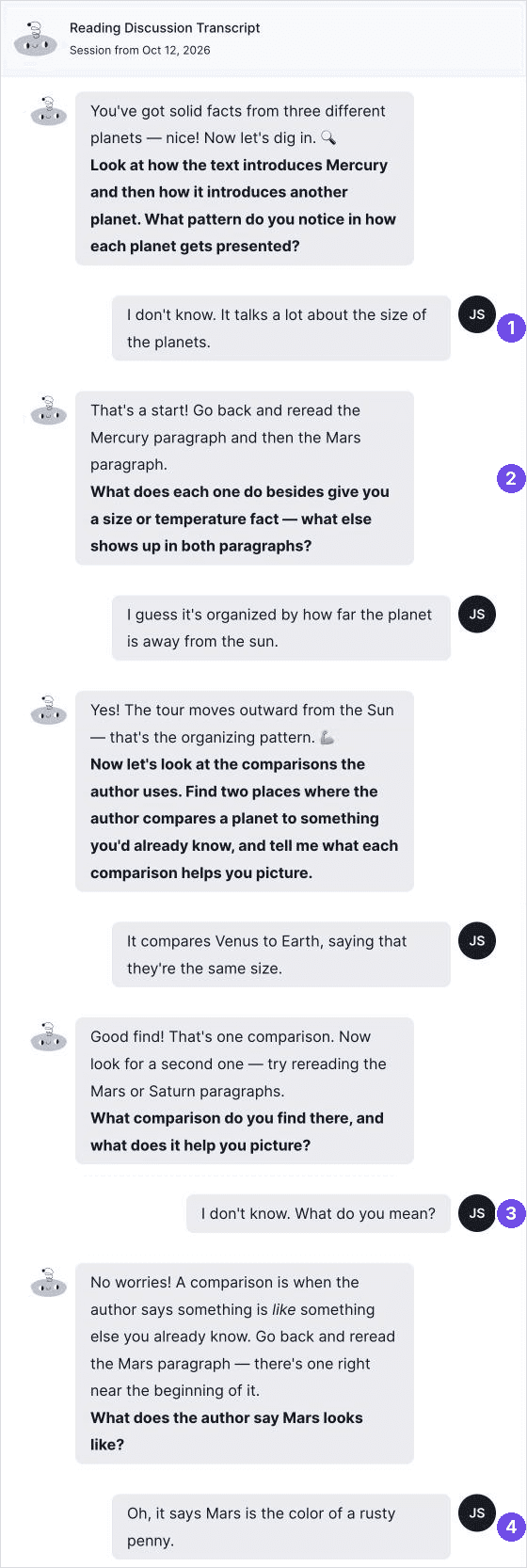
- An “I don’t know” counts against Phase Independence.
- The Reading Buddy does not give the answer; it sends him back to two paragraphs.
- He says “I don’t know” again on the next question.
- After the reread, he finds the answer himself.
- Before the next story, tell the student: “When you don’t know, go back to the story first and find the part the question is about, then answer.” That is what the Buddy’s hints do, so a student who does it first needs fewer of them.
- If independence stays at level 1 or 2 for three stories while the other measures hold up, the stories may be too hard for now. Move the student down a grade band from the Edit Student Account tab, and back up when the level rises.
Text Evidence: the answers do not point to the story. The student says “he was brave” or “it was hard” without anything from the text.
- Give the student a sentence starter and keep it by the computer: “I know because the story says ___.”
- In a two-minute conference, open the transcript, pick one answer with no story in it, and ask, “Where does it say that?” Then find it together.
Analytical Thinking: the student retells instead of explaining. The Dig In answers say what happened but not why, or give one idea in one short sentence.
- Ask for one because in every Dig In answer: “She felt better because ___.”
- Ask for a second example: “Where else in the story does that happen?” One example with a because is usually level 3; two or three connected examples is level 4.
Evaluative Thinking: the student has an opinion but no reasons, or hedges. The Weigh It answers say “it was good” or “I guess it was okay” and stop.
- Teach the three-part answer: what you think, why, and where the story shows it.
- Before the student judges, ask what would make it a good decision: “What would a good choice have to do?” Naming the standard first turns an opinion into a judgment.
The standards ratings
Below the four charts, the progress page rates the student on three Common Core reading standards for their grade. Each rating is fed by one measure (text evidence, analytical thinking, evaluative thinking), so the three cards tell you whether the student backs answers with the text, explains characters and events, and judges what he reads with reasons. Each shows Not enough data until the fourth story. After that, a standard is Proficient when the student’s levels on that measure across the last four stories average 3 or higher, and Developing otherwise. Only the last four count, so recent work is what shows.
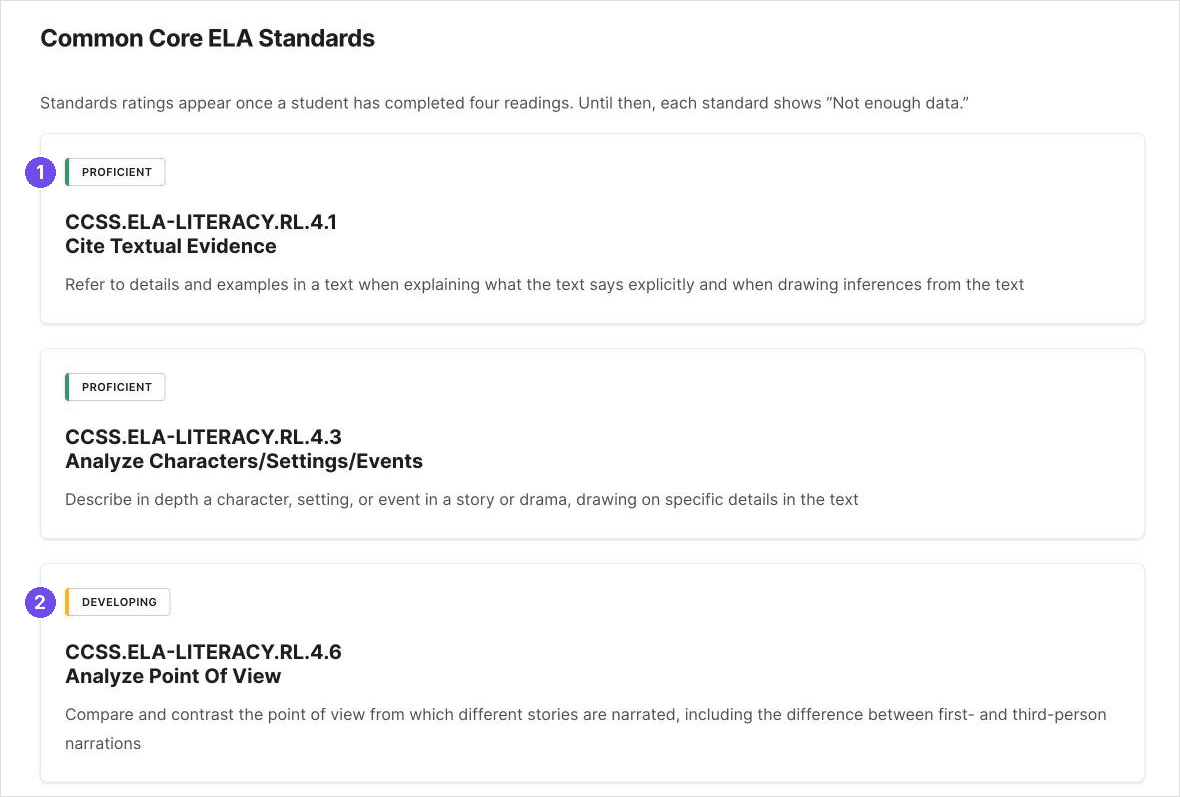
- Proficient means the measure feeding this card averaged 3 or higher over the last four stories.
- Developing here is Jim’s evaluative thinking, which went 2, 2, 3, 4 and averages just under 3.
If your state does not use Common Core, the ratings still describe what the student did. Your state’s reading standards for grades 3 to 6 ask students to support answers with evidence from the text, to explain characters and events, and to form and support a judgment about what they read. Find those three and read the three ratings against them.
Where to go next
Page 4 of CRJ in Your Week, The four phases, explains the four stops a student moves through in every story and how each connects to the measures above. Page 5, Finding the reports, shows you where every report and transcript lives.